
Case Study · Student Housing
CapMatch Case Study: The Marshall
Purpose-Built Student Housing Recapitalization at Saint Louis University
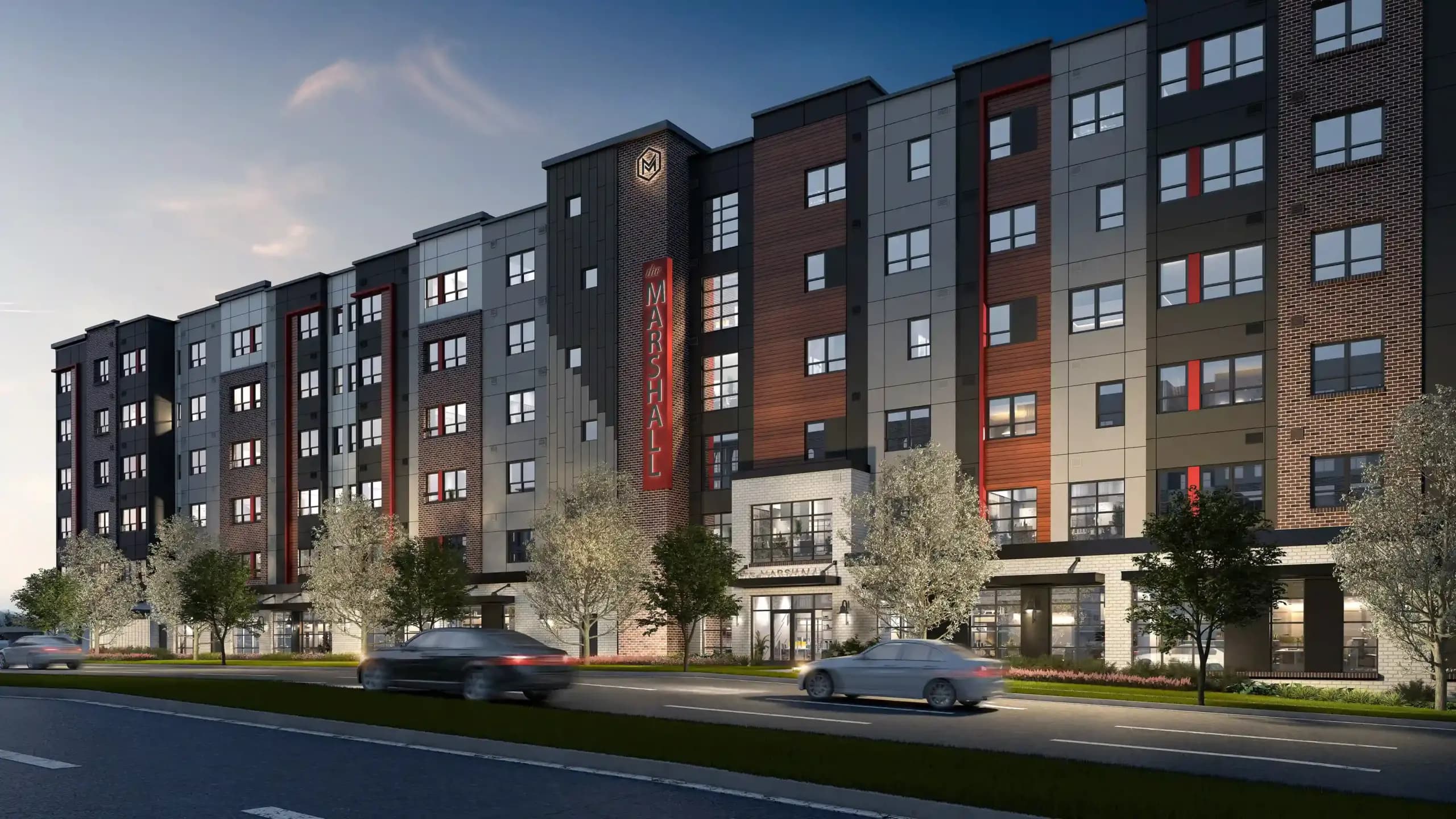
1. Deal Snapshot
- Asset Type: 177-unit, 508-bed purpose-built student housing community with 368,000 SF across five residential floors over a two-level parking podium
- Capital Sought: $30.1 million equity recapitalization for a 99%-complete development with strong pre-leasing momentum
- Borrower Profile: Joint venture between ACARA and Aptitude Development, combining institutional multifamily investment expertise with specialized student housing development experience
Why This Deal Was Complex: The Marshall recapitalization presented distinct challenges that resist conventional documentation approaches. The project operates in the specialized student housing sector, where underwriting conventions differ materially from traditional multifamily - beds rather than units drive revenue, lease terms align to academic calendars, and demand is tied to enrollment trends rather than employment statistics. The investment also carries Opportunity Zone tax benefits that require careful structuring to preserve, including capital gains deferral through 2026 and potential elimination of appreciation taxes after a 10-year hold. With 99% construction complete and over 60% pre-leased, the deal sits at an inflection point between development and stabilization - a transitional moment that static documents struggle to capture accurately.
2. The Challenge: Specialized Asset Class, Generic Documentation Formats
When the sponsor initiated the recapitalization process, prospective investors received a comprehensive package reflecting the deal's multidimensional structure:
- Market analysis documenting SLU's 25% enrollment growth since 2020, with back-to-back record classes in 2023 and 2024
- Competitive supply analysis showing only 162 purpose-built student housing beds delivered since 2017 against a student population exceeding 15,200
- Rent comparables from three competing properties - Verve St Louis, The Standard, and City Lofts at Laclede - each showing 96-100% occupancy and rent growth ranging from 18% to 37% annually
- Pro forma projections targeting 17.7% IRR and 4.29x equity multiple over a 10-year hold
- Opportunity Zone structuring details including 8% preferred return, annual distributions, and tax-free appreciation mechanics
- Construction progress documentation showing 99% completion with Q2 2025 occupancy timeline
The materials were comprehensive, but they created a persistent interpretation problem. Student housing investors approached the deal with bed-level economics in mind, but certain exhibits showed unit-level metrics. The Opportunity Zone benefits were described qualitatively, but investors needed to model their specific tax situations to understand personal impact. The competitive analysis showed historical rent growth, but prospective investors wanted to understand how those trends would affect The Marshall's Year 1 and Year 2 revenue.
Every investor conversation surfaced slightly different questions. One family office wanted to understand how the 8% preferred return compounded during the development period before stabilization. A fund focused on OZ investments asked whether the capital gains deferral applied to short-term or long-term gains, and how the 10-year clock interacted with the projected 2035 exit. A student housing specialist wanted granular detail on the pre-lease velocity - were the 60%+ pre-leases concentrated in certain unit types, and what did absorption look like by bedroom count?
Each question required the capital advisor to dig through source documents, extract relevant data, and construct a custom response. The static nature of the materials meant that every inquiry became a manual research project.
3. The CapMatch Intervention: Building an Investor-Ready Intelligence Layer
CapMatch processed the complete document package - market analysis, competitive set data, pro forma projections, and OZ structuring details - and constructed an integrated model that connected the deal's disparate components into a queryable system. The platform's automated analysis surfaced several insights that would otherwise have required significant manual effort:
- The 60%+ pre-lease rate was concentrated in 2-bedroom and 4-bedroom configurations, with 1-bedroom units lagging - a pattern consistent with student preference for shared living arrangements that reduce individual rent burden
- The competitive set showed vacancy rates between 0% and 4%, but two of the three comparables were older vintage (2006 and 2015), suggesting The Marshall's 2025 delivery could command a premium for modern finishes and amenities
- The pro forma assumed 3% annual rent growth, but the competitive set had achieved 18-37% growth in recent years - a conservative assumption that provided meaningful upside if market conditions persisted
- The Opportunity Zone structuring required capital deployment by December 31, 2024 to preserve the full deferral benefit, creating timing urgency that affected investor decision-making
CapMatch organized these findings into a structured data environment where each element could be interrogated independently or in combination. The pre-lease velocity could be viewed by unit type, by lease term, or by signing date. The competitive analysis could be filtered by vintage, by distance from campus, or by amenity set. The OZ benefits could be modeled against different investor tax profiles and holding period assumptions.
Rather than delivering a fixed narrative that required manual updates, CapMatch created an adaptive system that could respond to investor questions in real time.
4. Investor-Specific Outputs Without Redundant Customization
With the deal structured inside CapMatch, the capital advisor could generate tailored materials for each prospective investor without rebuilding the underlying analysis. For a family office focused on cash flow timing, CapMatch produced a distribution waterfall showing the 8% preferred return compounding through the development period, with projected annual distributions of 6-12% during the operating years and a final exit distribution in 2035. For an OZ-focused fund, the platform generated a tax benefit schedule comparing scenarios where the investor held short-term versus long-term gains, showing the dollar impact of deferral through 2026 and elimination of appreciation taxes after the 10-year hold. For a student housing specialist, CapMatch extracted bed-level economics across all seven unit types, showing effective rent per bed, pre-lease status, and competitive positioning against the local supply.
Anecdote: During a call with a prospective investor, the question arose: "What happens to occupancy if SLU enrollment flattens after years of growth?" The advisor queried the embedded AI assistant directly. Within seconds, CapMatch returned a stress analysis: even if enrollment held flat at current levels, the supply-demand imbalance would persist - SLU's 15,200 students were served by only 1,035 purpose-built beds including The Marshall, implying a bed-to-student ratio of 6.8% versus the national average of approximately 10%. The structural undersupply provided a buffer against enrollment volatility. The investor had their answer before the call concluded.
5. Embedded AI Assistance & Real-Time Investor Intelligence
Every CapMatch deliverable - whether an investor summary, a tax modeling schedule, or a competitive analysis - included an embedded AI assistant capable of answering questions directly against the underlying data. This capability proved especially valuable given the specialized nature of student housing underwriting.
When an investor asked about The Marshall's amenity differentiation versus the competitive set, the AI assistant itemized the comparison: professional fitness center, hot-tub complex, collaborative study spaces, individual study pods, entertainment room, café, and grilling stations - a modern amenity package that the 2006-vintage City Lofts and 2015-vintage Standard could not match. When a different investor asked about the major employers driving non-student demand, the assistant surfaced the proximity data: BJC Healthcare with 8,500+ employees at 0.6 miles, Washington University with 6,200+ at 0.6 miles, and the Cortex Innovation District with 5,700+ jobs at 0.5 miles - a secondary demand driver that provided occupancy support beyond the student population.
The embedded intelligence transformed investor diligence from a sequential question-and-answer process into a dynamic conversation. Prospective investors could explore the deal at their own pace, drilling into the specific elements that mattered to their investment thesis without waiting for the advisor to locate and extract information from static documents.
6. Outcome: Faster Capital Formation with Higher Investor Confidence
The Marshall recapitalization benefited from a materially improved investor engagement process:
- Accelerated diligence cycles: Investor questions that previously required overnight turnaround were resolved during live conversations, maintaining momentum through the capital formation process
- Reduced interpretation risk: Because all investor materials derived from a single validated model, there was no risk of conflicting figures between the market analysis, pro forma, and competitive study
- Enhanced investor confidence: Prospective investors could interrogate the deal directly rather than relying on curated summaries, leading to faster commitment decisions and cleaner documentation
- Sponsor efficiency: The development team used the same CapMatch environment to track investor feedback, model different capital structures, and prepare for closing - all without switching between disconnected systems
The capital advisor, rather than spending days fielding repetitive questions and manually customizing materials, focused on relationship management and deal execution - the high-value activities that actually drive capital formation.
7. Why This Matters: Specialized Assets Demand Specialized Infrastructure
The Marshall transaction illustrates a broader truth about capital formation for specialized real estate assets. Student housing, senior living, self-storage, data centers - each sector carries its own underwriting conventions, demand drivers, and risk factors. Generic documentation formats designed for conventional multifamily or office deals cannot adequately capture these nuances, forcing capital advisors into endless cycles of manual customization.
CapMatch addresses this limitation by treating deal data as structured intelligence rather than static content. Documents are ingested and organized into queryable models. Outputs are generated dynamically, tailored to each investor's format requirements and analytical preferences. Questions are answered in real time through embedded AI, eliminating the friction that slows capital formation and introduces error risk.
For sponsors, this means faster access to capital with less distraction from core development responsibilities. For investors, it means higher-confidence underwriting with the ability to explore deal-specific questions without waiting for advisor turnaround. For capital advisors, it means spending time on strategy and relationships rather than document management.
The Marshall is not an isolated example. It represents a new standard for how specialized real estate transactions should be capitalized - with intelligence, precision, and the adaptive responsiveness that modern investors expect.
Case study prepared by CapMatch. Deal details derived from actual transaction documentation. Certain operational details inferred to support narrative continuity.