
Case Study · Ground-Up Mixed-Use
CapMatch Case Study: SoGood Apartments
Ground-Up Mixed-Use Construction in Dallas's Southern Innovation Corridor
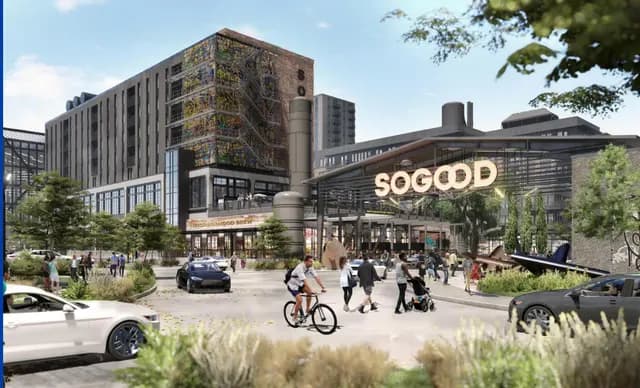
1. Deal Snapshot
- Asset Type: 116-unit mixed-use multifamily with 49,569 SF of commercial space including a pre-leased Innovation Center, ground-floor retail, and second-floor office
- Capital Sought: $18 million construction loan with permanent takeout
- Borrower Profile: Joint venture between Hoque Global (GP) and ACARA (LP), combining catalytic urban development expertise with institutional multifamily investment discipline
Why This Deal Was Complex: The SoGood Apartments financing presented a layered underwriting challenge that static offering memoranda struggle to accommodate. The project combines seven distinct residential unit types - including 76 affordable units restricted to 80% AMI - with three separate commercial income streams operating under different lease structures. A 30,000 SF Innovation Center carries a signed 10-year lease with GSV Holdings LLC featuring annual rent escalations. The deal also benefits from Opportunity Zone tax advantages and a property tax exemption structured through a Public Facility Corporation, requiring lenders to model multiple scenarios depending on their treatment of tax-advantaged income. No single PDF could capture the interdependencies between these components, and each lender approached the deal with different assumptions about how to value the mixed-use structure.
2. The Challenge: Disconnected Documents and Competing Underwriting Assumptions
When the capital advisor initiated the financing process, the borrower submitted a comprehensive package that reflected the project's inherent complexity:
- A 46-page construction financing request prepared by Northmarq containing market analysis, architectural plans, demographic data, and pro forma projections
- Multiple unit mix schedules showing both untrended and trended rent assumptions across seven floor plan types
- Commercial lease abstracts for the Innovation Center (NNN with scheduled escalations), retail suite, and office space - each with distinct economics
- A developer budget breaking down $29.8 million in uses across land, hard costs, soft costs, financing, and interest reserves
- Rent comparables from six competing properties in the Downtown Dallas and Farmers Market submarkets
- Sale comparables from five Class A transactions, none of which occurred in the immediate submarket
The documentation was thorough, but it created a fundamental problem: every lender who reviewed the package arrived at different conclusions about the deal's risk profile. One construction lender focused on the affordable housing restriction, questioning whether the 80% AMI rent caps would hold during lease-up. A regional bank wanted to stress-test the Innovation Center lease, modeling what happens if GSV Holdings exercises an early termination. A debt fund was skeptical of the 5.50% exit cap rate and requested sensitivity tables showing valuation at 6.00%, 6.25%, and 6.50%. Each question required the advisor to return to the source documents, extract data, rebuild assumptions, and generate a custom response - a process that consumed days and introduced reconciliation risk.
The challenge was compounded by the project's mixed-use structure. The residential pro forma showed Year 1 NOI of $2.27 million untrended, but this figure blended affordable and market-rate units, each with different vacancy and concession assumptions. The commercial income of $1.06 million annually included a pre-leased Innovation Center, speculative office space, and a small retail suite - three distinct risk profiles treated as a single line item. Lenders couldn't easily decompose the deal into its constituent parts, and the static PDF format offered no mechanism for dynamic interrogation.
3. The CapMatch Intervention: Structuring a Living Underwriting Model
CapMatch ingested the complete document package - including the Northmarq offering memorandum, architectural plans, lease abstracts, and developer budget - and constructed a unified deal model that preserved the relationships between components while enabling flexible output generation. The platform's automated processing identified several critical issues that would have otherwise surfaced mid-diligence:
- The pro forma vacancy assumption of 5% applied uniformly to residential units, but the affordable-restricted studios had materially different lease-up dynamics than the market-rate two-bedrooms - a distinction that warranted separate treatment
- The Innovation Center lease with GSV Holdings included annual rent bumps from $2.08/SF to $2.46/SF over the 10-year term, but the base case pro forma captured only Year 1 income without modeling the escalation schedule
- The developer budget included a $1.15 million interest reserve sized at an 8.00% construction rate, but the permanent takeout was modeled at 6.00% - a 200-basis-point spread that affected refinance proceeds and sponsor equity return
- The property tax exemption through the PFC structure was assumed in the base case but not stress-tested against a scenario where the exemption lapses or is challenged
CapMatch reconciled these elements into a structured data model where each assumption could be traced, modified, and tested. The Innovation Center lease was modeled as a discrete cash flow with its own escalation schedule and rollover risk. The residential component was segmented by AMI restriction, allowing lenders to apply different vacancy and rent growth assumptions to affordable versus market-rate units. The tax exemption was treated as a toggle, enabling instant comparison between abated and unabated scenarios.
The result was not a revised PDF but an interactive underwriting environment - a deal operating system that could generate tailored outputs without requiring manual reconstruction.
4. Lender-Specific Outputs Without Rebuilding the Model
With the deal structured inside CapMatch, the advisor could respond to lender requests in real time rather than queuing them for overnight turnaround. When a construction lender asked for a uses-of-funds schedule aligned to their draw format, CapMatch exported the $29.8 million budget with line items mapped to the lender's categories - land, hard costs (including 5% contingency), soft costs, financing, and reserves - without manual reclassification. When a debt fund requested a stressed cash flow showing the Innovation Center at 75% of contracted rent, the advisor toggled the lease assumption and generated an updated pro forma in minutes. When a regional bank wanted to see debt service coverage under a 30-year amortizing permanent loan at 6.00%, CapMatch produced the schedule instantly: $1.82 million annual debt service against $2.27 million NOI, yielding a 1.25x DSCR.
Anecdote: During a live call with a prospective lender, the credit officer asked whether the sponsor had modeled a scenario where the PFC tax exemption is revoked after Year 5. The advisor, using the embedded AI assistant, queried the system: "What is the impact on NOI if real estate taxes normalize to market rate in Year 6?" CapMatch returned the answer within seconds: based on the comparable tax burden for Downtown Dallas multifamily, normalized taxes would reduce Year 6 NOI by approximately $350,000, compressing the debt yield from 12.6% to 10.7%. The lender had their answer before the call ended - no follow-up email, no revised model, no delay.
5. Embedded AI Assistance & Dynamic Deal Intelligence
Every output generated by CapMatch - whether a lender-facing pro forma, an investor summary, or an internal memo - included an embedded AI assistant capable of answering questions directly against the deal data. This proved especially valuable given the project's Opportunity Zone structure and affordable housing component.
When the sponsor's tax counsel asked for a summary of the qualified opportunity zone benefits, the AI assistant extracted the relevant context: capital gains deferral through 2026, potential elimination of gains on appreciation held for 10+ years, and the requirement that the property remain a qualified opportunity zone business property through the hold period. When a lender asked whether the 80% AMI rent restrictions applied to all studios or only a subset, the assistant clarified: 76 of the 84 studios (48 S1 units and 28 S2 units) were restricted, while the 8 S3 studios were market-rate.
The embedded intelligence eliminated the need for the advisor to serve as a human lookup layer between lenders and deal documents. Questions that previously required a return to source materials - "What are the escalations in the GSV lease?" "How is the management fee calculated?" "What's the basis for the $257,000 per-unit cost?" - could now be answered instantaneously, with full traceability to the underlying data.
6. Outcome: Accelerated Execution with Reduced Friction
The SoGood Apartments financing benefited from a materially improved process compared to traditional construction loan origination:
- Compressed response cycles: Lender questions that previously required 24–48 hours of manual work were resolved in real time, keeping the deal in active underwriting rather than stalled in documentation queues
- Reduced reconciliation errors: Because all outputs derived from a single validated data model, there was no risk of mismatched assumptions between the rent roll, pro forma, and budget
- Enhanced lender confidence: Credit officers could interrogate the deal directly rather than relying on static summaries, leading to faster credit approvals and cleaner term sheets
- Sponsor visibility: The borrower team used the same CapMatch environment to track lender feedback, compare financing structures, and model equity returns under different scenarios
The advisor, rather than spending weeks managing document versions and fielding repetitive clarification requests, focused on what mattered: structuring the capital stack, negotiating terms, and positioning the deal for optimal execution.
7. Why This Matters: Construction Financing Reimagined
The SoGood Apartments transaction illustrates a structural limitation in how construction financing is typically originated. Ground-up mixed-use deals are inherently complex - they combine development risk, lease-up risk, and operational risk across multiple asset types, each with distinct underwriting considerations. Static documents flatten this complexity into fixed narratives that cannot adapt to lender questions or evolving assumptions.
CapMatch replaces this rigid workflow with a dynamic operating system that treats deal data as a living asset. Documents are ingested and reconciled into a unified model. Outputs are generated on demand, tailored to each lender's format and assumptions. Questions are answered in real time through embedded AI, eliminating the back-and-forth that consumes advisor bandwidth and delays execution.
For sponsors, this means faster access to capital and better visibility into their own deal economics. For lenders, it means higher-confidence underwriting with fewer clarification loops. For advisors, it means less time on document management and more time on deal strategy.
This is not an incremental efficiency gain. It is a fundamental reimagining of how construction debt gets placed - and a template for how complex commercial real estate transactions should operate.
Case study prepared by CapMatch. Deal details derived from actual transaction documentation. Certain operational details inferred to support narrative continuity.